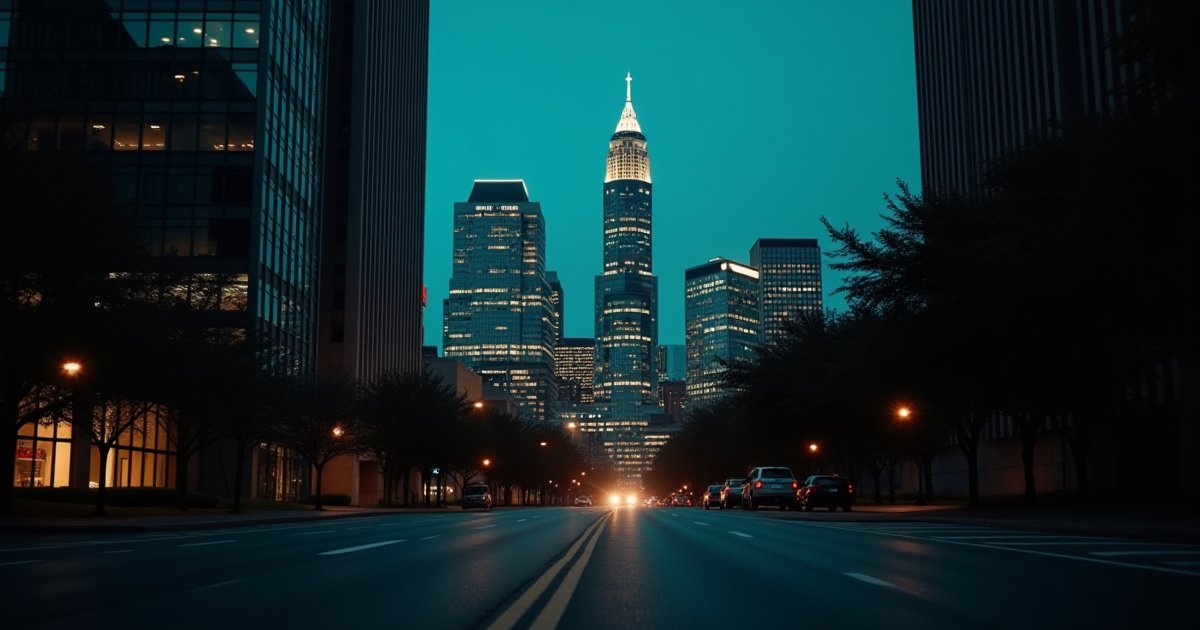
I've lived and worked in Charlotte long enough to watch it go from "where?" to "oh, the banking city" to whatever it is now, which is harder to summarize.
If you build software for a living, Charlotte is one of the better-kept secrets on the East Coast. Not because it's a Silicon Valley in waiting — it isn't, and the people running the city are right not to chase that — but because of a specific combination of things that you don't get in many other places.
The banking thing is real, and it's not the whole thing
Yes, Bank of America headquarters is downtown. Yes, Wells Fargo is the second-largest employer. Yes, the financial corridor moves billions of dollars of payroll and tech budget every year, and that's been a big part of what brought serious engineering work here in the first place.
But the more interesting story isn't the towers; it's what spun out of them. People who spent a decade building risk systems at the banks, or trading platforms at Lowe's, or cloud infrastructure at Honeywell, eventually leave and start something. Charlotte is full of these people. There's a deep bench of senior engineering talent that didn't come from a startup ecosystem — they came from making mission-critical systems work at scale, then decided they'd rather work on their own thing.
If you need to hire a developer who has actually shipped production code that handles real money, Charlotte has them. They're just not always on Twitter telling you about it.
The cost-of-living math is genuinely good
A senior engineer in Charlotte can buy a house in a walkable neighborhood, send their kids to decent public schools, eat at restaurants that would do fine in New York, and have margin left over. That math doesn't work in San Francisco, doesn't really work in Boston, and is increasingly not working in Austin.
For a small business, this matters in two ways. First, you can afford to pay senior people what they're actually worth. Second, the senior people you hire aren't constantly looking at remote offers in cheaper cities because they're already in one.
The "small but serious" thing
Charlotte isn't a startup town in the way Austin used to be. It's not crawling with seed-stage founders, the local VC scene is modest, and you can count the late-night co-working spaces on one hand. If your business plan requires the energy of being surrounded by other twenty-three-year-olds raising on a pitch deck, this isn't your city.
What it is, is a town full of small businesses that need real web development, real SEO, and real strategy — and have actual revenue to pay for it. Local manufacturers. Specialty contractors. Regional service businesses. Family-owned operations that have been running for thirty years and are finally ready to fix the website their cousin built in 2009.
This is honestly the work I find most interesting at this point in my career. The problems are concrete. The decision-makers answer the phone. The success metric is "did the business work better," not "did we close a B round." AwardsZone here in Charlotte is the long-running example — fifteen-plus years in, online sales tripled and the showroom got busier too.
Where the talent actually is
For anyone trying to put together a team here, the talent maps roughly like this:
- Uptown / South End — Banking refugees, fintech, a lot of senior engineers
- NoDa / Plaza Midwood — Creative-leaning developers, design-adjacent, smaller agencies
- Ballantyne / Indian Trail / Matthews — Lifestyle hires, established families, senior people working remotely for out-of-state companies
- University area — UNCC pipeline, junior to mid-level, strong CS program
- Lake Norman / Mooresville — Founders, owners, executives, surprisingly dense with technical leadership
It's a small enough town that within two or three degrees of separation, you can usually find anyone you need. It's a big enough town that there's depth in almost every specialty.
The remote-work effect
Charlotte was a beneficiary of the 2020-2022 remote work wave in a way that's still showing up. A lot of senior engineers who lived in higher-cost coastal cities moved here, kept their out-of-state salaries, and bought houses. They're still here, still working remotely for the same companies, and they're a huge underrated resource. They moonlight. They consult. They occasionally jump to local opportunities when something interesting shows up.
If you're a Charlotte small business trying to hire technical help, don't restrict yourself to people whose LinkedIn says "Charlotte." Half the actual Charlotte tech population is technically employed somewhere else.
What the city is missing
I'll be honest about what's still soft.
The local design community is thinner than the engineering one. You can find great backend developers easily; finding a great brand designer or product designer takes more work, and the best ones are often already booked.
The startup-funding scene is real but small. If you're doing anything venture-scale, you'll probably need to raise out of state. That's fine — most of the businesses I work with are bootstrapped or revenue-funded anyway.
And there isn't really a cohesive "Charlotte tech identity" the way Austin has one, or the way the Triangle has one with the universities. Charlotte tech is a federation of niches: banking tech, energy tech, sports tech (yes, that's a thing here), small-business consulting, real estate tech. The federation doesn't have a flag.
I'm honestly not sure that's a bad thing.
Why I stay
People ask me semi-regularly why I haven't moved to Austin or Raleigh or Atlanta. The honest answer is that Charlotte is good for the kind of work I want to do. The clients are real. The talent is deep. The city is comfortable. The traffic is fine. The barbecue is non-controversially better than wherever you live.
If you're building a small business in Charlotte and you need software help, the resources are here. You just have to know where to look. I'm one of them — see what I do for Charlotte businesses, from web development and AI integration to SEO, digital marketing, and media production.
I'm in Plaza Midwood, mostly, on a laptop. Always happy to talk shop.
Got a project in mind?
If something here sounds like the work you need done, drop me a line.
Get in Touch